LogButler DEA Compliance Blog
Home / Educational / The Full Cycle of Controlled Substance Management: From Ordering to Disposal
The Full Cycle of Controlled Substances Management: From Ordering to Disposal
Every controlled substance has its own journey, or lifecycle. The Controlled Substances Act (CSA) sets the federal requirements for how it should be handled every step of the way. It also lays the foundation for the DEA’s Closed System of Distribution — designed to keep controlled substances available for medical use only, while minimizing the risk of their diversion.
Let’s take a closer look at what the closed system is, why it matters, and what you, as a DEA registrant, need to know to stay compliant.
The Closed System of Distribution
So, what makes this system “closed”?
First, all legitimate handlers of controlled or scheduled drugs (manufacturers, practitioners, dispensers, etc.) in the closed system are registered and operate only under the DEA license (see DEA Practitioner’s Manual). So, no outsiders can access or administer scheduled drugs. Secondly, such registrants should account for every transaction by accurately documenting controlled drug usage and movements throughout its lifecycle.
In simple terms, it’s closed because the scheduled drug can only exist within this limited circle of authorized people. This creates a chain of custody when every step of the drug life cycle is recorded and traced back to a specific DEA registrant and patient.
Logging of controlled substances isn’t just something the DEA wants us to do but rather the only right way to safely and properly manage any scheduled drug within the DEA’s Closed System of Distribution.
How to Manage Controlled Substances Throughout Their Lifecycle
So, how do you know that you’re properly managing controlled substances within the DEA’s closed system? It starts with the routine for tracking every controlled drug and logging all activities across its lifecycle.
Facilities build this routine with the help of Standard Operating Procedures (SOPs) based on both federal and state regulations. These are internal written hospital policies that actually establish the exact workflow for the facility to handle controlled substances.
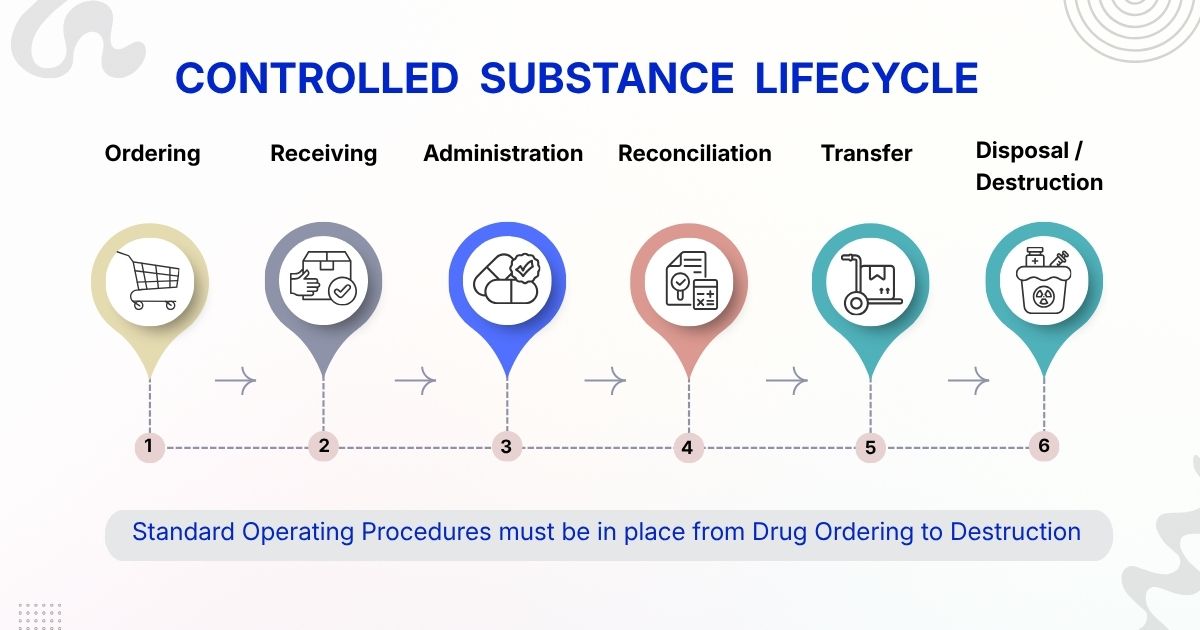
Their lifecycle begins long before it gets to the veterinary hospital. However, for veterinarians ordering is always the first touchpoint. At this stage, SOPs should detail who’ll be responsible for ordering, what distributors will be, how you’ll order medications (through 222 Forms or CSOS online), etc.
When the drug has been delivered to your clinic, that’s when the real documentation begins. Breaking down all the steps in your SOPs will help organize this process. When receiving a drug, you need an authorized person who will handle its storing and logging all the details such as the life of the container, container information on the invoice, its storage location, etc.
Every time you administer a drug to a patient or dispense it to a client, you must log all the details of the transaction. This includes client-patient information, the drug name, its schedule, amount used, remaining balance, reason for use, etc.
To have accurate records, you’ll need regular inventory reconciliation (including physical counts) to spot errors, discrepancies and fix them timely. It means comparing and documenting inventory logs with the actual quantity of drugs on hand.
During the transfer of a controlled drug from one storage location to another, you should log this step, assigning a new storage, time, reason of transfer, and an authorized person’s name.
If you dispose of drugs in a hospital, you’ll need to have a well-documented workflow that is fully DEA compliant. For destruction / disposal, many veterinarians choose an external provider to delegate that responsibility.
During this controlled drug journey, well-designed SOPs become essential to help practices stick to protocols built around regulatory requirements. They also make everyone stick to the same process and workflows.
Yet, even the best SOPs in a well-organized facility may fail if the personnel struggle with their paper records and keeping a trail of all the transactions. And it’s often not the fault of a facility but because paper logbooks are too overwhelming and time-consuming. They create too much repetitive and manual work, which often leads to errors, typos, and discrepancies.
That’s why many facilities try to pair up their SOPs with digital logbooks. They turn SOPs from documents that collect dust on a shelf into actual policies and procedures used in everyday facility’s operations.
How a Digital Logbook Supports the Controlled Substance Lifecycle
Now that we understand how the DEA’s Closed System of Distribution works, one thing is clear: facilities must account for every controlled substance throughout its lifecycle to stay compliant and prevent diversion. But simply having written SOPs isn’t just enough to make sure that happens.
After all, even the most elaborate procedures are only effective if your team has the right tools to follow them consistently. Because when a team relies on paper logs, spreadsheets, manual calculations, exhausting reconciliations and physical counts, accurate tracking of every movement becomes a challenge.
As a result, logging and documentation takes more time, mistakes occur more often, and inventory differences are harder to find and fix.
A digital logbook is designed to support your facility’s standard operating procedures. It basically brings them to life by providing the standard logging workflow and guided steps embedded in it.
Plus, in Logbutler, for example, you can tailor such procedures to your specific workflows, team structure, and operational needs.