
LogButler Controlled Substances Solution
LogButler DEA Compliance Blog

How Drug Schedules Work: Navigating e-CFR with Confidence

If you’ve ever browsed through Title 21 in the e-CFR (Code of Federal Regulations), you already know how complex the Controlled Substances Act (CSA) can be. For many busy practitioners with continuous patient flow, learning every CFR detail is often daunting (only Title 21 contains about 2,500 pages of data).

However, CSA highlights that all healthcare providers, administrators, physicians, clinicians, and medical personnel with access to controlled drugs have to comply with the federal laws. And let’s not forget about state regulations.
Yet, among dozens of terms in e-CFR, the first you should learn are categories or schedules of controlled drugs.

What Are Drug Schedules and Their Examples?

controlled substances schedule

It is the Controlled Substances Act that provides clear-cut classification of controlled drugs, substances, and some chemicals that fall into five essential schedules. You’ll find their full lists with assigned 4-digit code numbers in Part 1308 of e-CFR.

Understanding them as well as the rules for handling scheduled drugs and their records is still a challenge for many clinics.
Why? Because apart from the federal laws gathered in the CSA, practitioners should also conform to their state regulations that may vary and change in time. Some state laws may be more stringent in some cases and take precedence over federal requirements.
Federally, there are five accepted categories of controlled substances – from Schedule I to Schedule V. However, some states go even further by adding Schedule VI and Schedule VII drugs, making extra layers of regulations that can be stricter or more lenient.
Today we’ll study those schedules that are regulated at the federal level. Each drug has its own class schedule based on these three essential factors:
  • The likelihood of abuse: We’re still in the middle of the opioid crisis, especially synthetic opioids like fentanyl. The authorities Drug Enforcement Administration (DEA) in collaboration with FDA and HHS determine the scheduling of drugs. First, FDA and HHS analyze and estimate scientific and medical value of drugs and their potential of abuse. Then, based on that data, the DEA decides how to classify drugs.
  • Accepted medical use: Such drugs should be scientifically approved as effective and safe for specific medical purposes.
  • Dependency potential: Controlled drugs often pose risks of addiction and harm to a patient in cases of misuse, use disorder, or intentional abuse. The most common safeguards are drug scheduling, appropriate prescriptions, and DEA’s diversion control program.
The latter establishes a healthcare provider’s responsibility for non-compliance and traceability of prescription drugs. This program starts with DEA registration, recordkeeping and security standards, PMP programs, and often ends up with unannounced on-site inspections, and penalties for violations. To avoid fines (e.g., 1 infringement will cost you $18,000 as of the end of 2025), you should know perfectly how drugs are scheduled and rules to their keeping, dispensing, and recording.

Let’s have a look at classification of controlled substances according to CFR guidelines.

Schedule I Drugs (CIs)

Because these medications carry the highest addiction risks and severe health consequences, they are not approved for treatment of patients. Yet, CIs can be utilized in approved studies and clinical trials if scholars get the permit for a research from the DEA (and sometimes the FDA too).

Schedule-1 drugs:

  • Have a high potential for abuse
  • Have no acceptable medical use in the U.S.
  • Lack safety even when used under medical supervision.

Examples: heroin, gamma hydroxybutyric acid (GHB), lysergic acid diethylamide (LSD), marijuana, and methaqualone, etc.

Schedule II Drugs (CIIs)

The C-II drugs are often prescribed to treat extreme pain, ADHD, insomnia, anxiety, etc. Yet, when misused and prescribed improperly, they are highly addictable (psychologically and physically). That is why, compared to other medications (CIII-CV), schedule 2 drugs are the most regulated.

Schedule-2 drugs:

  • Have a high likelihood to be abused, but less than Schedule I drugs
  • Almost always leads to dependence if misused or abused
  • Some medically accepted uses – with restrictions
  • Cannot be refilled, a new prescription must be issued
  • Must be stored separately from other drugs (at least not at the same shelf)
  • All CII drug records must be maintained apart from other records
Examples: morphine, methadone, hydrocodone, fentanyl, oxycodone, pentobarbital, methamphetamine, hydromorphone, etc.

To know how to simplify C-IIs recordkeeping and compliance, ask for a demo of a LogButler’s digital logbook!

Schedule III Drugs

Unlike with Schedule II drugs, the abuse of Schedule III drugs more often causes psychological dependence rather than physical. In clinical practice they are widely used to manage pain, provide anesthesia, and suppress appetite for weight control.

Schedule-3 drugs:

  • Less potential for abuse than schedule I and II
  • Medically accepted uses
  • Moderate to low dependence compared to schedules above
  • Refills are allowed – no more than 5 in 6 months

Examples: barbiturates, ketamine, buprenorphine, benzphetamine, anabolic steroids, opioid analgesics (no more than 90 mg of codeine)

Schedule IV Drugs

This class of drugs is commonly used to treat anxiety, insomnia, seizures, muscle spasms, depression, panic, or phobias, sedation, etc.

Schedule-4 drugs:

  • Low potential for abuse compared to schedules above, but misuse may still occur
  • Limited to low dependence compared to schedules above
  • Medically accepted uses
  • May be prescribed verbally, with paper or electronic prescriptions
  • Some Schedule IV drugs can be issued for pain control
  • Five refills during 6 months can be used.
Examples: alprazolam, clonazepam, and diazepam, butorphanol, lorazepam, midazolam, tramadol, etc.

Schedule V Drugs

CV medication often contains a limited quantity of narcotics but still requires a prescription. They are commonly dispensed to suppress cough, cold, treat diarrhea, manage pain (mild-moderate), etc.

Schedule-5 drugs:

  • Lowest potential for abuse compared to schedules above
  • Medically accepted uses
  • Limited dependence compared to schedules above
  • 5 partial fills in 6 months are allowed
Examples: Cough medicines with codeine of no more than 200mg per 100ml, antidiarrheal that contain atropine, pregabalin, diphenoxylate, etc.

How to Identify the Schedule of a Drug
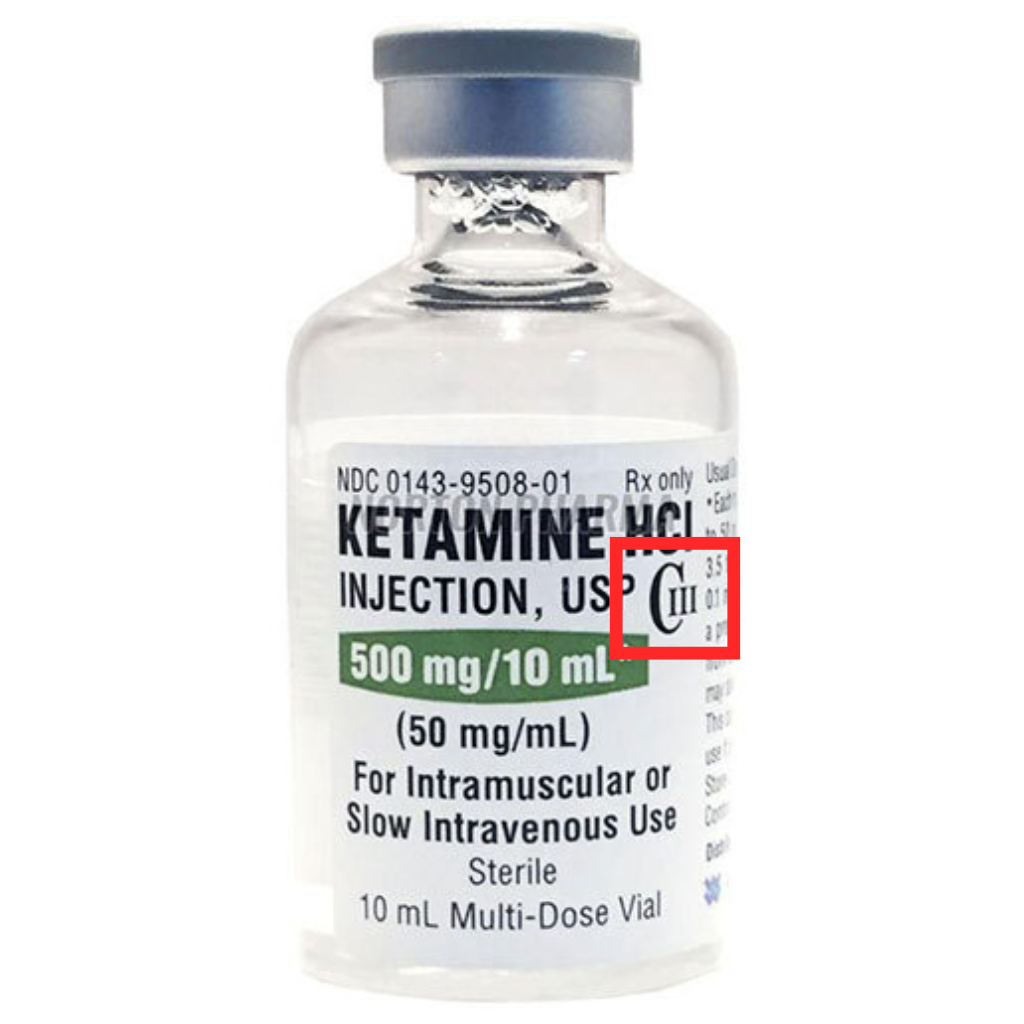
schedule drug example
One of the most reliable ways to determine the schedule of a specific medication is to check the container itself and its packaging.

All controlled substances must display their schedule classification (CII, CIII, CIV, CV) directly on the label of a container or bottle. You can also find this data by reviewing your ordering invoices, visiting the manufacturer’s website, or browsing the CFR website.

Keep in mind that the schedule of a drug may change over time – a substance that is currently not listed as a controlled drug could later become classified at either a state or federal level. Thus, healthcare providers should constantly follow all regulations concerning that medication to be able to adjust their recordkeeping workflows accordingly.

Why Drug Scheduling Is a Primary Pillar for Compliant Recordkeeping?

Drug schedules define not only potential and medical use of a specific substance but also requirements for its storage, administration, and recordkeeping. Depending on the class of a drug, the severity or requirements may vary. For example, CII storage and record details should be comprehensive, requiring daily reconciliation, separate storage, security controls, and prescription reporting.
In regard to drug schedules, practices should ensure policies and procedures and employee training sessions to properly handle, dispense, and dispose of controlled substances. Practitioners should also maintain a variety of documentation, like DEA forms, invoices, packing slips on site, supporting transactions of each schedule of drugs at their clinics.

All federal requirements can be found on the CFR website. Be sure to check with your state for any regulations that may differ from the federal regulations.

Conclusion

The scope of requirements for controlled substances management is enormous and their severity greatly depends on the schedule of a specific medication. Disregarding them today is no longer an option. Because non-compliance leads to penalties that may result even in the license suspension or practice shutdown.
To help you stay on track with all of the requirements to recordkeeping and managing controlled substances, we’ve created a LogButler digital logbook that allows handling different drug schedules with less effort.

Request your LogButler demo to become more confident in your records and comply with all DEA rules and regulations.